
Scholar Profile: Jennifer Angel-Amaya
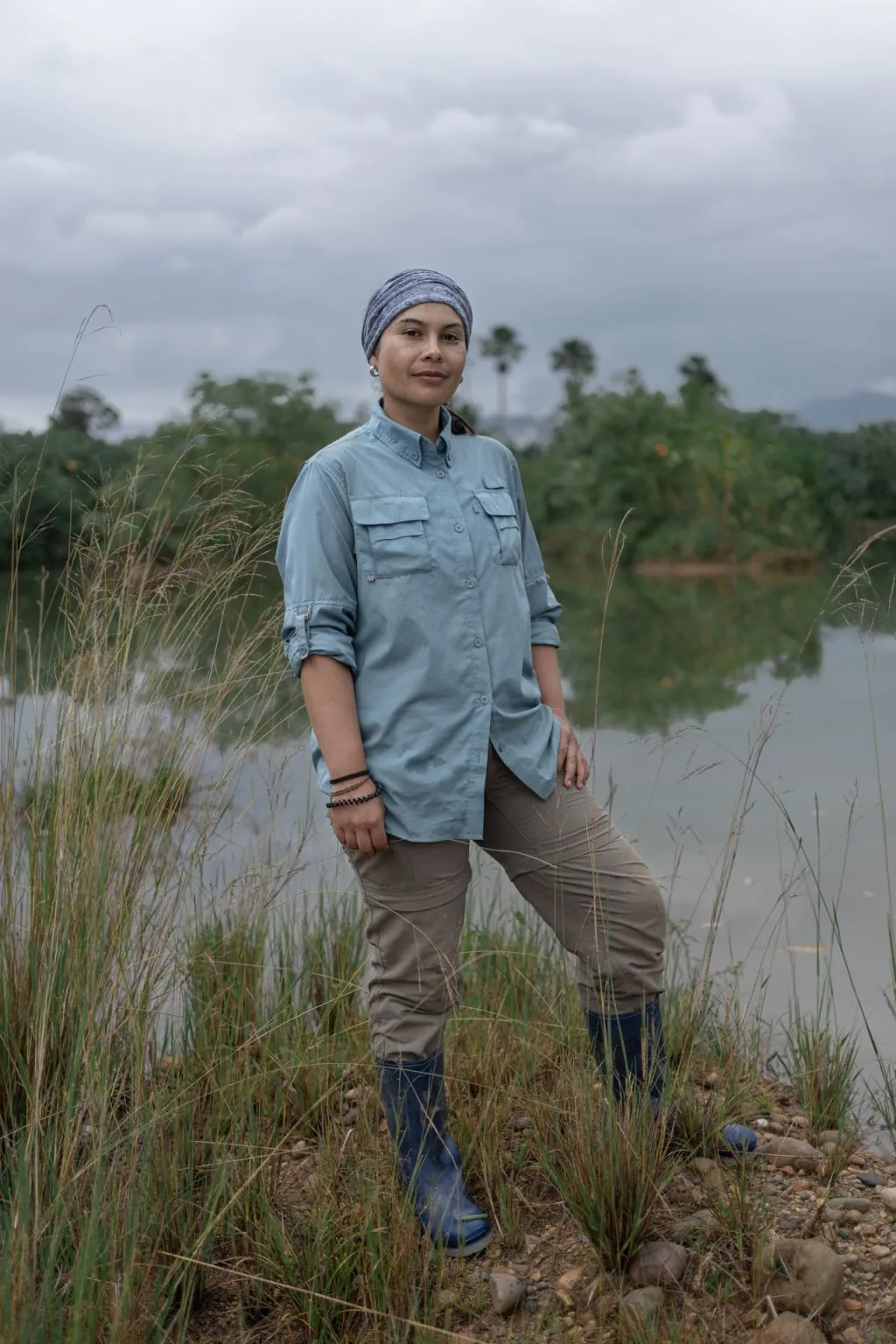
Credit: Lujan Agusti
Jennifer Angel-Amaya didn’t start her scientific career intending to address mercury contamination from gold mining in the Amazon. She started it by analyzing ultramafic rocks from the Earth’s mantle.
Angel-Amaya, currently a Ph.D. candidate in Environmental Sciences at Columbia, describes her early work as “pure science for the love of the game.” After earning a bachelor’s in geology in her native Colombia and a Master’s in Geochemistry in Brazil, she analyzed the chemical and geologic mechanisms surrounding ultramafic rocks and conducted marine fieldwork. But as the geopolitical landscape of her home country shifted, so did her focus. Following the de-escalation of Colombia’s civil war, areas of the countryside opened up to fieldwork, leading Angel-Amaya to join the Ministry of Environment and Sustainable Development where she conducted audits and wrote environmental impact statements. To bolster this work, Angel-Amaya then joined Columbia as a Fulbright Scholar in July 2021.
Angel-Amaya is also part of the National Geographic Society–Rolex Perpetual Planet Amazon Expedition, where she tracks the movement of mercury, used to separate gold from sediment, through soils, water, and food webs. Her goal is to develop a scientific certification method for “mercury-free gold,” creating an incentive that could protect both the ecosystem and the health of Indigenous and local communities.
During our conversation, one of the most striking observations was Angel-Amaya’s consideration toward the miners as part of the solution. Angel-Amaya told me that in areas with a lack of alternatives, controlled by complex business interests and weak regulations, mining is often the only economic lifeline for families.
“Why don’t people switch to mercury-free methods? It takes more time, money, training, and experience,” Angel-Amaya explained. She drew a parallel to the consumer market, noting that just as people pay premiums for organic food or ethically sourced diamonds, there must be financial incentives for miners to change their methods. “Miners would need a a higher price,” she told me. Her research aims to provide the scientific framework for a supply chain transparency that could make mercury-free mining financially viable.
Another observation from our interview was the tension Angel-Amaya feels between the slow pace of academic research and the rapid speed of environmental degradation. She spoke candidly about the difficulties of securing funding for issues that aren't prioritized by federal agencies. For example, while climate change was the “trendy” topic a few years ago, priorities have since rapidly shifted based on politics.
It was also interesting to note how Angel-Amaya embodies a shift from “geologic time” to “human time.” While her background in geology taught her to look at million year cycles, her current work is driven by an urgency to deploy solutions now. “Science tends to go slow,” she said, reflecting on the process of peer review and publication. “[We need] solutions for people to deploy fast. You sometimes feel hopeless, like, it's not gonna change... but if you don't believe possible change [is coming], you won't continue doing it.” To Angel-Amaya, geology is not just about observing the Earth as it was, but about intervening in what it is becoming. As Angel-Amaya told me: “It’s not just enough to know [what] has been done, but also, how can we prevent it?”